| Taboo GT Home | | | News | | | Gallery | | | Construction Notes | | | Building Guide | | | Building Tips | | | Ordering Taboo GT | | | Items For Sale |
coming soon to a flying field near you!
 Welcome and thanks for visiting the home page of
Taboo GT
- one of the best vacuum bagged hand launch
gliders on the market today.
If you're looking to pry your kids away from the new awesome space game on the computer or just get them outside playing, the Taboo GT may be a fantastic way to do it. It is extremely easy to fly, a breeze to build, durable and has great handling characteristics that make it a real joy.
Taboo GT has been in constant evolution since it was first introduced
in 2005. Since that time we have introduced a lot of small improvements into the design, but we did not feel
that there was a need to rename the model since the general look and feel of the model remained
the same. Instead of renaming the model we decided to keep the familiar name and continue
improving the performance.
Welcome and thanks for visiting the home page of
Taboo GT
- one of the best vacuum bagged hand launch
gliders on the market today.
If you're looking to pry your kids away from the new awesome space game on the computer or just get them outside playing, the Taboo GT may be a fantastic way to do it. It is extremely easy to fly, a breeze to build, durable and has great handling characteristics that make it a real joy.
Taboo GT has been in constant evolution since it was first introduced
in 2005. Since that time we have introduced a lot of small improvements into the design, but we did not feel
that there was a need to rename the model since the general look and feel of the model remained
the same. Instead of renaming the model we decided to keep the familiar name and continue
improving the performance.
In 2010 a new revision has been done to the wing of TabooGT. The airfoils have been upgraded to a new series based on the mix of Zone-52/40/25 and HM-51 airfoils. The new airfoils have been tested in contests in 2010 and wings have been already supplied to several customers. The response has been positive. The model now has a slightly wider speed range. The minimum speed has not changed appreciably, while the performance at higher speed has been markedly improved. The model also launches slightly higher now. In combination with kevlar/foam bagged tails the model performs now nearly as well as many very expensive molded models on the market. The wing planform was not changed, but the aileron chord has been set at the original 30% mark for most of the span except near the tip of the wing where it is slightly under 30% for better flutter resistance. The spar has been moved forward to the point of the maximum thickness, such that the servos now must be installed behind the spar. This servo location reduces the linkage length and improves cointrol system stiffness. Builders who want to experiment with RDS installation can now do it easier since there is plenty of space behind the spar for the servo and RDS installation  Taboo GT is an extremely easy and honest model to fly. You will be hard pressed to find a hand launch
model with better handling. The light wing tips, a judicious amount of washout, well balanced tail
areas and moments - all these features allow the model to "dance" in the lightest thermal bubbles,
while having a respectable high speed performance. When ballasted, Taboo GT can handle the strongest
winds and will come back for a far away thermal with dignity.
Taboo GT is an extremely easy and honest model to fly. You will be hard pressed to find a hand launch
model with better handling. The light wing tips, a judicious amount of washout, well balanced tail
areas and moments - all these features allow the model to "dance" in the lightest thermal bubbles,
while having a respectable high speed performance. When ballasted, Taboo GT can handle the strongest
winds and will come back for a far away thermal with dignity.
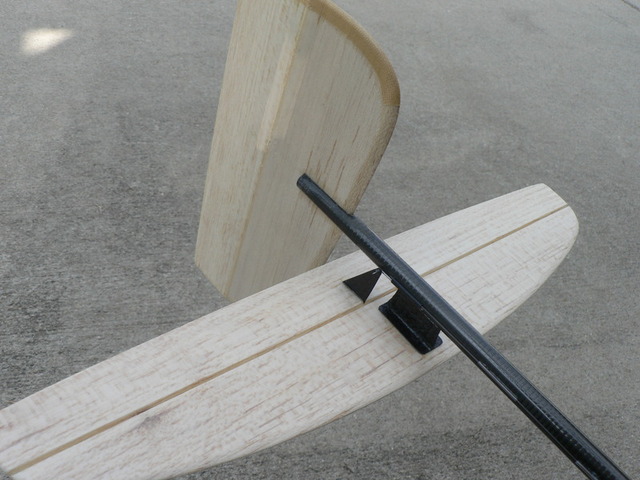 Taboo GT remains to be one of the easiest, if not THE easiest, hand launch kits to assemble for the
builder (that is you). The pod and boom fuselage provides adequate strength and stiffness for the most
demanding launches, while keeping the fuselage weight to a minimum. The ballast chamber is integrated
into the tailboom. The open pod design gives you an unmatched access for radio gear installation or for
any potential adjustments and repairs later. The pod has enough space for nearly any combination of
radio gear, including full size receivers and 9 gram servos. Our latest preference for the fuselage
servos are Hitec HS-45, JR-241 or equivalent (JR-285, SM-22) servos. Experience shows that the extra
performance and precision of the good quality but heavier 7-9 gram servos is well worth the additional
weight. For the
wing servos it is nearly impossible to match the performance of Hyperion Atlas DS09 servos.
Taboo GT remains to be one of the easiest, if not THE easiest, hand launch kits to assemble for the
builder (that is you). The pod and boom fuselage provides adequate strength and stiffness for the most
demanding launches, while keeping the fuselage weight to a minimum. The ballast chamber is integrated
into the tailboom. The open pod design gives you an unmatched access for radio gear installation or for
any potential adjustments and repairs later. The pod has enough space for nearly any combination of
radio gear, including full size receivers and 9 gram servos. Our latest preference for the fuselage
servos are Hitec HS-45, JR-241 or equivalent (JR-285, SM-22) servos. Experience shows that the extra
performance and precision of the good quality but heavier 7-9 gram servos is well worth the additional
weight. For the
wing servos it is nearly impossible to match the performance of Hyperion Atlas DS09 servos.
When it comes to durability and repairing damaged wings, like any foam core wing model Taboo GT allows you to contain the damage to a minimum, and easily restore the model back to a flying condition. The damage is usually non-fatal and with enough diligence almost any wing can be returned back to a good shape. It may not fly as good as when it was new, but it will be very close. Taboo GT is a great competition DLG model which excels in calm and windy conditions. It's guaranteed to give many hours of enjoyment to a serious competition pilot or a weekend sport flyer. Give it a try, you won't regret it! |
| Taboo GT Home | | | News | | | Gallery | | | Construction Notes | | | Building Guide | | | Building Tips | | | Ordering Taboo GT | | | Items For Sale |